Have you ever wondered about the origins of that trusty kitchen companion that speeds up your meals and tenderizes even the toughest cuts of meat? The pressure cooker, a staple in millions of kitchens worldwide, boasts a rich and fascinating history spanning over three centuries. From its humble, somewhat perilous beginnings as a “Digester” designed to soften bones, to the sophisticated electric models of today, the journey of the pressure cooker reflects remarkable advancements in culinary technology and a persistent quest for efficiency and safety in cooking. Join us as we explore the pivotal moments and ingenious minds that shaped this indispensable appliance, revolutionizing how we prepare food, one pressurized meal at a time.
What is a Pressure Cooker?
At its core, a pressure cooker is a sealed vessel that traps steam generated when its contents are heated. This trapped steam builds pressure inside the cooker, which in turn raises the boiling point of water beyond its usual 100°C (212°F). The higher temperature and intense pressure dramatically accelerate the cooking process, making food tender in a fraction of the time compared to conventional methods. This ingenious principle is what has allowed the pressure cooker to remain relevant through centuries of culinary evolution.
The Dawn of Pressure Cooking: Denis Papin’s Digester (1679)
The story of the pressure cooker begins in the late 17th century with the innovative mind of Denis Papin, a French physicist, mathematician, and inventor.
The Inventor and His Vision
|
Our Picks for the Best Pressure cooker in 2026
As an Amazon Associate I earn from qualifying purchases.
|
||
| Num | Product | Action |
|---|---|---|
| 1 | Instant Pot Duo 7-in-1 Electric Pressure Cooker, Slow Cooker, Rice, Steamer, Sauté, Yogurt Maker, Warmer & Sterilizer, Includes App With Over 800 Recipes, Stainless Steel, 6 Quart |

|
| 2 | Our Place Dream Cooker - 6 Qt Ceramic Nonstick Multicooker & Pressure Cooker with Touchscreen Controls & Auto Steam Release - 4 Modes: Pressure Cook, Sauté/Sear, Slow Cook & Warm - Blue Salt |
|
| 3 | Our Place Dream Cooker - 6 Qt Ceramic Nonstick Multicooker & Pressure Cooker with Touchscreen Controls & Auto Steam Release - 4 Modes: Pressure Cook, Sauté/Sear, Slow Cook & Warm - Spice |
|
| 4 | COMFEE' 9-in-1 Electric Pressure Cooker, 14 Presets Instant Multi Cooker Olla de Presion Non-Stick Pot Yogurt Maker Rice Cooker Slow Cooker Sauté Steamer 6 Quarts Black |
|
| 5 | Instant Pot Duo 7-in-1 Mini Electric Pressure Cooker, Slow Rice Cooker, Steamer, Sauté, Yogurt Maker, Warmer & Sterilizer, Includes Free App with over 1900 Recipes, Stainless Steel, 3 Quart |
|
| 6 | Stove Top 304 Stainless Steel Pressure Cooker, One-hand Easy Handle Lid, 3 PSI Setting, 6 Safety Systems, Dishwasher Safe, Olla de Presion, Works for All Cooktops (8.5 QT) |
|
| 7 | Instant Pot Duo 7-in-1 Electric Pressure Cooker, Slow Cooker, Rice Cooker, Steamer, Sauté, Yogurt Maker, Warmer & Sterilizer, Includes App with Over 800 Recipes, Stainless Steel, 8 Quart |
|
| 8 | CHEF iQ Smart Pressure Cooker with WiFi and Built-in Scale - Easy-to-Use 10-in-1 Multicooker with 500+ Guided Recipes - Rice Cooker, Slow Cooker, Instant Meals for Foodies - 6 Quart - Family Size |
|
| 9 | Our Place Dream Cooker - 6 Qt Ceramic Nonstick Multicooker & Pressure Cooker with Touchscreen Controls & Auto Steam Release - 4 Modes: Pressure Cook, Sauté/Sear, Slow Cook & Warm - Steam |
|
| 10 | COSORI Pressure Cooker 6QT, Stainless Steel, 9-in-1 Multi Cooker, 12 Safety Features, Ceramic Inner Pot, Rice, Slow Cook, Sous Vide, Saute, 1100W |
|
Born in 1647, Denis Papin was a polymath who studied medicine before becoming an assistant to prominent scientists like Christiaan Huygens and Robert Boyle. His work with Boyle, particularly on the relationship between pressure and volume (later formalized as Boyle’s Law), profoundly influenced his most famous culinary invention. Papin’s primary objective for his “Digester” was not just convenience, but social improvement: he sought a way to make cheaper, tougher cuts of meat more palatable and digestible, thereby improving the diet of the working poor.
Early Design and Royal Society Presentation
In 1679, Papin unveiled his groundbreaking invention, which he called the “Digester” or “Steam Digester.” This early prototype was a large, cylindrical, sealed chamber designed to be heated over coals, capable of reaching pressures up to eight atmospheres and temperatures around 175°C (347°F). He presented his creation to the prestigious Royal Society in London that same year, where it garnered significant interest from luminaries such as Isaac Newton and Robert Hooke. The Society was so impressed that they commissioned his book, “A New Digester or Engine for Softening Bones,” published in 1681. The following year, Papin hosted a famous “Digester dinner” for the Royal Society, where guests like diarist John Evelyn marvelled at how the device could render even the “hardest bones of beef itself… as soft as cheese.”
Initial Challenges and Dangers
Despite its revolutionary potential, Papin’s original Digester was far from a household appliance. It was cumbersome, expensive to produce, and notably dangerous due to the lack of adequate safety mechanisms. Without reliable safety valves to release excess pressure or secure locking lids, the early Digester was prone to explosions if not handled with extreme care, a significant barrier to widespread adoption beyond scientific circles.
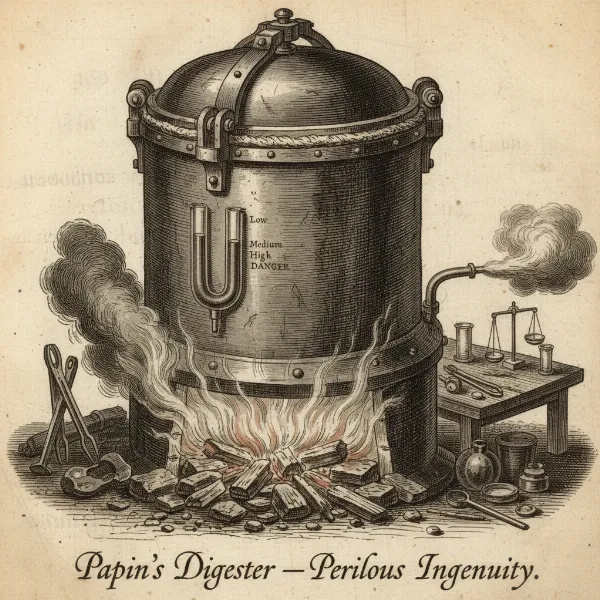 Illustration of Denis Papin's 17th-century steam digester, a dangerous early pressure cooker with no safety valve.
The Industrial Age: Early Adaptations and Patents (19th – Early 20th Century)
The fundamental concept of pressure cooking lay dormant for widespread commercial use for nearly two centuries, as engineers and inventors grappled with making it safer and more practical.
From Laboratories to Early Commercial Use
The 19th century saw gradual improvements in metallurgy and engineering, paving the way for more robust and reliable pressure vessels. In 1864, Georg Gutbrod of Stuttgart, Germany, began manufacturing pressure cookers made of tinned cast iron, marking one of the earliest steps towards commercial production. These were primarily industrial models, used in canneries and large institutions.
Key Patents and Innovations
Significant strides in making pressure cooking accessible for broader use came in the early 20th century. In 1918, José Alix Martínez in Spain was granted a patent for his “olla exprés,” literally meaning “express cooking pot,” a term that captured the essence of the device. The popularity grew sufficiently for the first pressure cooking recipe book, “360 fórmulas de cocina Para guisar con la ‘olla expres’,” to be published in 1924, showcasing its emerging role in everyday cooking.
The Rise of the Domestic Pressure Cooker (Mid-20th Century)
The mid-20th century marked a transformative period for the pressure cooker, as it transitioned from a specialized tool to a common household appliance.
From Expedition Essential to Household Item
Before reaching the average kitchen, the pressure cooker found niche but vital applications. By the 1930s, its ability to cook quickly at higher altitudes, where lower atmospheric pressure makes conventional cooking difficult, made it an invaluable tool for mountaineering expeditions, including those attempting Mount Everest. This demonstrated its practical utility in extreme conditions.
The real breakthrough for home use came in 1938 when Alfred Vischer introduced his “Flex-Seal Speed Cooker” in New York. This model was specifically designed for the domestic market, made from aluminum and stainless steel, and its success spurred competition among manufacturers in the U.S. and Europe, accelerating mass production.
Wartime Setbacks and Post-War Resurgence
World War II, however, brought a temporary halt to this momentum. The demand for aluminum for wartime production led to a dip in pressure cooker manufacturing, and some companies resorted to using cheaper, substandard materials. This unfortunate period resulted in an increase in accidents and explosions, damaging the public’s trust and leading to a decline in popularity in the West, further exacerbated by the rise of modern stoves and convenience foods.
Despite this setback, the post-war era saw a significant resurgence. By 1949, domestic pressure cookers became more readily available in Britain, “hailed with delight” as a symbol of modernity and efficiency in the kitchen.
Global Spread and Initial Safety Concerns
The 1950s witnessed the introduction of pressure cookers to new markets, notably India, where brands like Hawkins and TTK Prestige began popularizing them. However, issues with spurious spare parts and improper handling continued to pose safety challenges in some regions, reminding manufacturers of the critical need for robust safety measures.
The Era of Safety and Widespread Adoption (Late 20th Century)
The true integration of the pressure cooker into mainstream domestic cooking hinged on overcoming its reputation for danger. The 1970s proved to be a turning point.
Pioneering Safety Features and Legislation
Recognizing the need for user confidence, manufacturers and regulatory bodies worked to implement rigorous safety standards. The 1970s saw a tightening of safety legislation, leading to the incorporation of multiple, redundant safety features. These included spring-loaded valves, fusible plugs that melt to release pressure in an emergency, and interlocks that prevent the lid from being opened while the cooker is pressurized. These innovations transformed the pressure cooker from a potentially hazardous device into a safe and reliable kitchen appliance.
Becoming a Kitchen Essential
With enhanced safety and reliability, the pressure cooker became an indispensable tool for countless households. By the 1980s, it was a kitchen essential across various cultures, from urban homes to rural settings, valued for its ability to cook tough foods quickly and efficiently, even on simpler heat sources like wood-fired stoves.
The Modern Pressure Cooker: Electric, Smart, and Versatile
Today’s pressure cookers bear little resemblance to Papin’s original Digester, evolving into sophisticated appliances that blend tradition with cutting-edge technology.
Electronic Advancements and Multicookers
The late 20th and early 21st centuries ushered in the era of electric pressure cookers. These self-contained units integrate heating elements, precise pressure sensors, and microprocessors, offering unparalleled control and automation. The advent of multi-cookers, epitomized by the Instant Pot, has further expanded capabilities, combining pressure cooking with slow cooking, sautéing, steaming, and even yogurt making, all in one appliance. This versatility has made them incredibly popular, especially among busy home cooks.
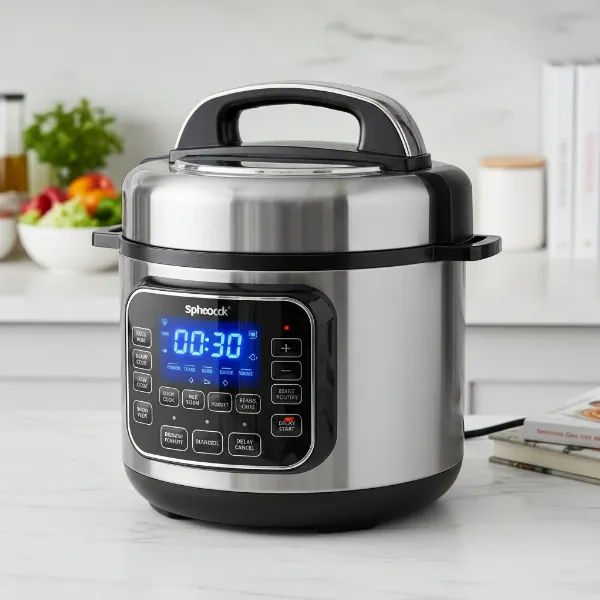 A sleek, modern electric multi-cooker like an Instant Pot, showing digital display and multiple function buttons.
Continued Focus on User-Friendliness and Safety
Modern pressure cookers prioritize user-friendliness and safety above all else. Digital displays, pre-programmed settings for various foods, and automatic pressure release functions simplify the cooking process. Advanced safety mechanisms, including multiple redundant valves, lid-locking systems, and anti-block shields, ensure that contemporary pressure cookers are remarkably safe to operate, a far cry from their volatile ancestors.
Comparing Modern Pressure Cookers with Past Iterations
The evolution is stark: from a heavy, temperamental “bone digester” requiring careful monitoring, to lightweight, intelligent devices that can be set and left to work with minimal supervision. The progression highlights not just technological advancement, but also a deeper understanding of culinary science and consumer needs.
The Enduring Benefits of Pressure Cooking
Across centuries, the core advantages of pressure cooking have remained constant, making it a valuable technique in any kitchen.
Faster Cooking Times
The most immediate benefit is speed. By raising the boiling point of water, pressure cookers can reduce cooking times by up to 70% for many dishes, a huge advantage for modern, time-pressed lifestyles. Tough cuts of meat and fibrous vegetables can be tenderized in a fraction of the time usually required.
Nutrient Retention
Contrary to popular belief, pressure cooking can help retain more vitamins and minerals compared to traditional boiling or steaming. The shorter cooking times and minimal use of water mean that heat-sensitive nutrients are less exposed to degradation and leaching.
Energy Efficiency
Faster cooking translates directly into energy savings. Because food cooks more quickly and the sealed environment prevents heat and steam from escaping, pressure cookers use significantly less energy and water than conventional cooking methods. This makes them an environmentally friendly and economical choice for the kitchen.
Conclusion
From Denis Papin’s ambitious 17th-century “Digester” to the intelligent multi-cookers of today, the pressure cooker has journeyed through a remarkable history of innovation, adaptation, and continuous improvement. It has evolved from a scientific curiosity and a risky experiment to a safe, efficient, and versatile kitchen essential, consistently delivering on its promise of faster, healthier, and more economical cooking. Its enduring appeal lies in its fundamental principle: harnessing the power of steam to transform ingredients, making delicious meals accessible to all. So, the next time you hear that familiar hiss or whistle, take a moment to appreciate the centuries of ingenuity that went into making your pressure cooker the culinary hero it is today. What will the next century of pressure cooker innovation bring?
Frequently Asked Questions
Who invented the first pressure cooker?
The first pressure cooker, known as the “Digester” or “Steam Digester,” was invented by the French physicist Denis Papin in 1679. He designed it to soften bones and cook tough foods more efficiently.
Why was the early pressure cooker dangerous?
Early pressure cookers, like Papin’s Digester, were dangerous because they lacked essential safety features such as reliable pressure release valves and secure lid-locking mechanisms. This made them prone to uncontrolled pressure buildup and explosions if not handled with extreme caution.
When did pressure cookers become safe for home use?
Pressure cookers began to become genuinely safe and popular for home use from the late 1930s onwards, especially with Alfred Vischer’s Flex-Seal Speed Cooker. However, widespread adoption and significant safety improvements, driven by tightened legislation and redundant safety features, truly took hold by the 1970s.
What are modern pressure cookers like compared to historical models?
Modern pressure cookers are vastly different from historical models. Today’s versions, especially electric multi-cookers, feature advanced electronic controls, precise temperature and pressure sensors, multiple automated safety mechanisms, and pre-programmed cooking settings, making them highly efficient, versatile, and exceptionally safe to use.